15 October 2008

Director Spotlight: Jean-Luc Godard


Oui, you guessed it: It's time to dissect the work of France's most well-known modern film director, and father of the Nouvelle Vague. Drumroll, s'il vous plait! It's Jean-Luc Godard!

He started as deftly employing Jean-Paul Belmondo as his affable, louche criminal in Breathless. The film is often noted as the first foray into the French New Wave of filmmaking --second maybe to to Truffaut's 400 Blows. [I won't go into what the French New Wave is in this post (view upcoming post devoted to it), but just know that it deals with 'jump cuts' and less conventional narratives, among other things like voiceovers and subversive topics --two of JLG's trademarks.] He also employed his then-wife, Swedish actress Anna Karina, as the femme protagonist in the majority of his 1960s films.

Godard's trademarks are his ridiculous non-narrative structure, forays into surrealism & use of philosophical tropes. When I watch I get the feeling I'm just listening to him recite Heidegger, Kant, Marx or Sartre, while Anna Karina bats her eyes in technicolor. It's unnerving sometimes, and that's why he is a true auteur in the filmmaking world: he doesn't bend to popular, conventional film themes or demands. Uniquely French, frankly unique. Amazing.

Breathless is a story about a petty thief, Michel Poiccard (Jean-Paul Belmondo), who tries to convince Patricia (Jean Seberg) to flee to Italy with him. She is an American student working for the New York Herald Tribune, and he steals cars & cash under an alias, Laszlo Kovacs. An unlikely pairing, but they prove to be a delight onscreen. He tough but sweet, she sweet but tough. Parfait!

Some of my other favorites:

A Woman is A Woman (1961)- Karina & Belmondo in musical-cum-love triangle narrative

Contempt (1963)- Brigitte Bardot & Michel Piccoli in the antithesis of romance in Italy

Band of Outsiders (1964)-Karina, Claude Brasseur & Sami Frey in a French take on American gangster movies

Alphaville (1965)- Karina & Eddie Constantine in a twisted, fascist-Sci-Fi -film noir

Pierrot Le Fou (1965)- Karina & Belmondo in a Bonnie & Clyde remake of odd proportions

Masculin Feminin (1966)- Jean-Pierre Léaud & Chantal Goya in "The Children of Marx and Coca-Cola."


11 October 2008

Director Spotlight: Jean-Pierre Melville


Jean-Pierre Melville epitomized the nouveau film noir or neo-noir movement in France in the 1960s and early 1970s. His love of American crime movies in the 1940s and 1950s served as the impetus behind his career as a filmmaker. Born Jean-Pierre Grumbach, he adopted "Melville" as nom de famille due to his fascination with the writer Herman Melville. In his early years he was known to watch 4 or 5 films a day, and was a real cinephile. After his first successful film, Le Silence de la Mer, in 1949, he went on to film a very notable (and controversial) adaptation of Jean Cocteau's Les Enfants Terribles in 1950. Overall, Melville's success was due to his unbelievable attention to form, and his penchant for keeping his films independent (often serving as producer, writer, director, he also had his own studio in Paris). People could say that he is to film noir what Sergio Leone was to spaghetti Westerns. Sadly, his career was cut short when he suffered a heart attack at age 55 in 1973. Nonetheless, he remains the master of cold-hearted cool.

Les Enfants Terribles is a beautifully constructed meditation on the obsessive love between two siblings. The story itself is very Cocteau-esque, dealing with the secretive and deranged world of the misunderstood and ultimately tragic youth. Narrated by Cocteau, the film is often mistaken as his creation, rather than Melville's. It is not a typical Melvillian film because of this: Cocteau served as a consultant to the film, and many images, albeit with Melville behind the camera, are clearly Cocteau's creation. This sensitive and convoluted subject of ownership still resonates today when viewing this film: who was the real creator behind it? Needless to say, Melville's quick departure from literary film adaptation was a smart choice, since he went on to film some of the best neo-noir and French crime pictures in his later career. He was so very attentive to detail, it was almost cringe-worthy (see Un Flic commentary for specifics). Yet, that was his style and established himself as a real auteur in French film history.

Bob Le Flambeur (1956) [commentary coming soon]

Jean-Paul Belmondo trio(!):

[Melville was quick to entice JPB to film a trio of movies after co-starring with him in Jean-Luc Godard's amazing film, Breathless (1960) --side note: Melville played a nihilist author, Parvulesco; my favorite quote: "What is your greatest ambition in life? Answer: To become immortal, then die."---
JPB encapsulated that humourous, self-deprecating gangster so well that Melville had to have him in his movies. Commentary coming soon.]
Leon Morin, Pretre (1961)
Le Doulos (1962)
L'Aine des Ferchaux (1963)

Le Deuxieme Souffle (1966)

Le Samourai (1967)

Melville's first film with Alain Delon proved to be a grand success, on both ends. Delon played the character so effortlessly. Melville employs the anti-hero typical in most crime movies, and sets theme up in austere, minimalist backdrops in virtually unidentifiable parts of Paris and the suburbs. The dialogue is sparse, the gazes steely-eyed, the decisions cutthroat, the mood sombre. In the end the film is a tough look at what really lies beneath the slick, sad, sobering lifestyles of criminals and their adversaries.

Le Cercle Rouge (1969)

Delon's second film with Melville was an ensemble cast, with Delon teamed up with Gian Maria Volonte and Yves Montand (who btw is beyond excellent as the reclusive ex-cop who suffers from horrible drug-induced hallucinations). Against the will of le commisaire (played by Bourvil), they seek to rob a famed Place Vendome jewellry store and make out for one last heist. Doomed, as always, the criminals meet their fate. One of my favorite scenes is the most sympathetic, where Bourvil comes home to his apartment to feed his cats. It's a calm scene (one can't help but think he'll come home to see them dead, poisoned by the very foe he's out to catch), but lends to the humanistic nature of Melville's directing. He likes to portray these men as humans, despite the cruel and cold environments in which they exist (for Bourvil, the police bureau, for Corey et al, the criminal world they create amidst the rest of society).

Un Flic (1972)

In his last film, Melville has the opening scene a blustery rainy day marred by a bank hold up. Turns out the robber, Simon, a nightclub owner (and lover of Cathy, played by Catherine Deneuve), is friends with the cop who investigates the heist (played by Delon, natch). The film lags on a bit and we're left wondering what the real point of it was, since Delon and Deneuve really don't shine and Simon's character starts off hopeful but ends up getting cut in a quick and easy, no-explanations sort of way. The scene that really sticks is probably the same for most viewers, since it's the longest sequence and fails to resonate with the overall mood of the film. Simon successfully spelunks his way on top of a moving train via a helicopter (Mission Impossible-style, with egregious toy models serving as wide angle shots of helicopter-et-moving-train-stand ins. WTF?!) On the train, we sit through Richard Crenna undressing in the bathroom: painstakingly, he puts on a robe and slippers, washes his face, combs his hair, and presents himself as a sleeping traveler. This scene is long and really doesn't make a lot of sense: why do we have to watch every single movement he makes? In the end, he's cut short of really establishing his motive and his character, despite that scene. Although not his best film, it was Melville's last, and worth watching.

07 October 2008

Actor Spotlight: Alain Delon


Ah, Alain Delon. He's been likened to James Dean of American cinema, with his weathered good looks, charm, and reckless 'tude. He stands, in my opinion, one of the best actors of the neo-noir film genre, and rivals Jean-Paul Belmondo as France's greatest export (outside of luxury goods: fur, fragrance, fromage, champagne, wine & jewelry). His roles are often the lonely, laconic criminal. Most notably he appeared in a string of Jean-Pierre Melville's neo-noir films, Le Samourai (1967), Le Cercle Rouge (1970), and Melville's final film, Un Flic (1970). He also appeared in softer roles, like opposite Monica Vitti in Michelangelo Antonioni's L'Eclisse (1962).

In Le Samourai, often hailed as Melville's chef-d'oeuvre (masterpiece), we see Delon playing Jef Costello, a quiet man living in a spartan Paris apartment, with nothing but neatly stacked mineral water bottles, a suit, trench coat, and hat, and his loyal companion- a bird in its gray wire cage. He sets out on a hit, only for it to go awry once he is seen by multiple people. As the intrigue rolls along, he's confronted by the police, his employers, his girlfriend (played by his then-wife, Nathalie), and the witnesses. He evades them all like a tiger in the jungle, as the opening quote states: "There is no greater solitude than that of the samurai, unless it be a tiger in the jungle, perhaps.."

In Le Cercle Rouge, Delon plays another criminal, a theif named Corey, and teams up with Yves Montand and Gian Maria Volonte to rob a prestigious Place Vendome jewellry store in Paris. Cold, contemplative and slick, Delon keeps it minimalist as per usual.

In Un Flic, Delon goes against type and plays a cop, Edouard Coleman, who is out to to catch a bank robber who turns out to be a friend, nightclub owner Simon (played by Richard Crenna). While clearly on the "right" side of the law in this film, he remains aloof and even manages to have an affair with Simon's girlfriend Cathy (played by Catherine Deneuve).

Side note: all of his Melvillian characters have American names (Costello, Coleman, Corey). An obvious nod to the American crime genre. Nicely done, Melville.


25 September 2008

Director Spotlight: Michelangelo Antonioni


Michelangelo Antonioni can be best remembered as an aesthete. His films were never lacking in beauty, and his long shots and sparse dialogue were some of his trademarks in cinema. He was the filmmaker's filmmaker, choosing visuals over dialogue and substance over form. In between his neorealist beginnings, and his later successful English film, Blowup (1966), lies a 'trilogy' of films devoted to love, life, and meaning. They are L'Avventura (1960), La Notte (1961), and L'Eclisse (1962).

L'Avventura starred a then-unknown Monica Vitti, as Claudia, a girl who goes on a yacht trip with her best friend, Anna (Lea Massari), Anna's boyfriend, Sandro (Gabriele Ferzetti), and some rich friends. Anna starts the film expressing her lackadaisical feelings for Sandro and her life situation. After swimming off the coast of Sicily, the crew ends up on a deserted volcanic island. Hours pass, and as the friends are ready to leave, Anna goes missing. As the party disperses on their search, Claudia and Sandro develop feelings for each other. Existential themes abound, Claudia expresses her confusion and inner turmoil, now that she is in love with her missing best friend's boyfriend. The two of them embark on a voyage that is part vacation, part search for Anna, part diversion from reality. The rest of the party goes on forgetting that Anna disappeared without a trace. This movie is particularly haunting because of the stark contrast of the beautiful imagery to the cold indifference of the characters. Sandro and Claudia exhibit ineffable feelings, pure and human. The film ends in sad portrayal of love and life lost.

In La Notte, we see a similar disconnect between man and woman. Marcello Mastroianni plays Giovanni, an established author, and Jeanne Moreau (speaking perfect Italian), his wife. The film surrounds a day in the life of the couple, where they visit a dying friend, go to a book party for Giovanni, a nightclub, and then a fancy party in the suburbs. Sparse dialogue, and beautifully cut scenes populate most of the film. Most scenes have at least one shot where the camera is docked at one focal point and the action flows in and out, as if we're observing rather than trailing the plot along. Jeanne's character appears disinterested, sad, and bored, while Marcello's Giovanni is pained and tired. Together they form 1/2 a couple, with neither really attempting to put in more effort to salvage their marriage. It resonates as a 1960s marriage set upon a post-industrial Italian modernist society, and the failures and existential issues each individual must deal with. Monica Vitti plays Giovanni's potential love interest, with great charm and success. Another beautiful story from a true modernist.

L'Eclisse, starring Vitti as Vittoria, and Alain Delon as Piero, glides along a similar theme of a woman's search for meaning in a reality less than spectacular. Vitti is engaged to Francisco Rabal, but their engagement ends within 15 minutes of the film's opening. Antonioni uses the camera well, by slowly focusing on images, faces, and stares, and holding our attention to his symbolism (an empty picture frame, the reflection of her shoes on the glossy lacquered floor of Rabal's apartment, etc). After dumping Rabal, Vitti ends up with stockbroker Delon, only to find that she's just as unhappy. This film is harder to analyse than his previous two, since the ending montage leaves much to the imagination. L'Eclisse (the Eclipse) could refer to the eclipse of Vitti's heart after two failed relationships, or the eclipsing of urban life by suburban ennui (she inhabits the lonely, dreary suburbs of Rome, full of apartment complexes, construction projects, vacant parking lots, and incessantly burning street lamps). Either way, this film is more morose than the others, yet we see Vitti smiling and laughing, which lightens it up towards the end. Regardless, it's a fitting end to a humanistic, modernist film trilogy.

22 September 2008

Director Spotlight: Ingmar Bergman


Ingmar Bergman was an existential hero. His movies were imbued with the melancholy, philosophical renderings of fellow Scandinavian Soren Kirkegaard. His movies were not only extensions of existential thought, but were treatments of the absurd, sad, and bizarre aspects of human life.

He employed his actors in roles that often times were inscrutable and devoid of logical truths. Some of his most remarkable works were the most difficult to decipher. He had a long, fruitful career, and enjoyed a meaningful life. He was an inspiration to any filmmaker (Woody Allen cites him as his idol), and to cult and foreign film adorers alike. He made many, many films over the course of his 60 year career, and some of them I highlight below. If you were to glean anything from his oeuvres, it would be this: he is auteur theory exemplified.


The Seventh Seal (Det Sjunde Inseglet), 1957
Wild Strawberries (Smultronstallet), 1957
Persona, 1966
Fanny and Alexander (Fanny och Alexander), 1982

[commentary coming soon]

11 September 2008

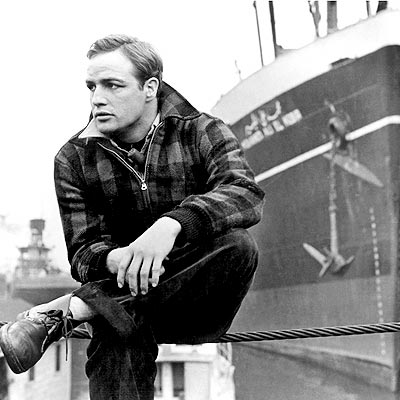
Actor Spotlight: Marlon Brando


Marlon Brando was a legend. He established himself in performing on stage, but with Elia Kazan's film direction, he showcased his amazing character portrayals on film. His role in Elia Kazan's On the Waterfront cemented his acting credibility. Elia Kazan's portrayal of the mob on the docks in 1950s New York was melancholy, gritty, and spectacular. Brando surged forward with that role. Playing tough but sweet Terry Malloy, a former boxer turned docksman, he is forced to confront his mobster brother and his own role in the death of a friend. (My favorite quote: "I coulda had class. I coulda been a contender. I coulda been somebody, instead of a bum, which is what I am.") Up against the mob, this movie was a thinly-veiled story about a good vs. 'evil' trial that Elia Kazan faced when he turned over famous actors, directors & writers (including Arthur Miller) to the House of Un-American Activities Committee, run by Sen. McCarthy, in the 50s. With that frame of reference, the backstory makes the movie resonate on a whole other level. Quite amazing.

Getting back to Brando, most will remember him for his role as Don Corleone in Francis Ford Coppola's The Godfather. I like to think of him in his subtler roles. For example, he excelled in Bernando Bertolucci's 1972 film, Ultimo Tango A Parigi (Last Tango in Paris). In this movie all the sick & twisted parts of his character come out in a perfect portrayal of love, lust and sadness in Paris in the 1970s. Gorgeous!

[Commentary on Mutiny on the Bounty and Apocalypse Now coming soon!]


Scene from Last Tango in Paris is below:


08 September 2008

Actor Spotlight: Al Pacino


It goes without saying that Al Pacino is one of the best film actors to come along in the last half century. With every role he throws himself into the character. From sad-eyed, heroin addict Bobby in The Panic In Needle Park (which helped catapult him to stardom in his next film, The Godfather), to hard-lined, vengeful Tony Montana in Scarface (yes, I had to go there), he compels the viewer to sympathize with him and ultimately, root for him. He's always up against something-- there's always a struggle (existential or external)-- amidst a backdrop of the human condition: famiglia, drugs, identity, love, what matters.

My favorites (in somewhat chronological order):

The Panic in Needle Park (1971, breakout role)

Pacino's first role was Bobby, a young drug dealer living at 72nd and Broadway in New York. That intersection, officially called Sherman Square, was known colloquially as 'Needle Park', where all the drug addicts congregated. Bobby meets a young girl named Helen, who dated a fellow user before they got together. He exposes her to the drug world, which to her was fascinating, and for him was just a way of life. He rises to the level of drug king, meanwhile Helen sinks into a seedy underworld, using, abusing, hooking and being an accomplice to Bobby's illegal ways. Although Bobby harbors genuine feelings and intentions for Helen, his character is inherently flawed and so addicted that he can't help but fall into one trap after the next. Pacino plays it so well it's hard to hate him. Quite the opposite, he evokes sympathy and we fall for him like Helen does.

The Godfather (1972, dir. by Francis Ford Coppola, Oscar nom)
The Godfather: Part II (1975, dir. by Francis Ford Coppola, Oscar nom)

Michael Corleone was his plum role. He starts off as a kind-hearted ex-Military man who shuns the family 'business', date Diane Keaton and lives in New York. When the attempted hit comes on his father (played by Marlon Brando), his character starts to turn. He becomes the ruthless, vindictive, hard-core Pacino that we really love. Although his trademark loud outbursts have yet to originate here, this role starts him on a trajectory that is nothing short of stellar. A role of a lifetime.
Favorite quotes: "It's nothing personal, Sonny. It's strictly business."
"Keep your friends close, and your enemies closer."


Serpico (1973, dir. by Sidney Lumet, Oscar nom)

Dog Day Afternoon (1975, dir. by Sidney Lumet, Oscar nom)

In this Sidney Lumet film, based on the true story of a robbery that happened in Brooklyn in 1973, Pacino plays Sonny, a lovesick anti-hero that attempts to rob a bank to secure cash for his boyfriend to have a sex change. (That part isn't even revealed until later, when Chris Sarandon, who plays his 'wife', comes into the film in a ridiculously amazing supporting role.) He's low-key, subtle, and sensitive when dealing with the hostages in the bank. But when interacting with the cops, and soon after the FBI, he starts his trademark outbursts: "Attica! Attica! Attica!" he yells, referencing the Attica jail riots where the cops tried to suppress the inmates and all hell broke loose. The scenes have a heavy backdrop of 1970s liberal anti-establishment sentiment, which resonates even today. A great piece of history cemented in film: it captures a single day, a single moment, a single story. Beautiful.


**I'm not putting Scarface in here, I think its glorification undermines his other performances (feel free to disagree)***

Glengarry Glen Ross (1992, dir. by James Foley, Oscar nom)

Scent Of A Woman (1993, dir. by Martin Brest, Oscar win)

"Hoo-Ah!" This movie was interesting. I like the theme of innocent schoolboy vs. curmudgeonly old cynic, but the score, in my opinion, is too sentimental and weepy. The movie is great for one reason only: Pacino. His tone and cadence is what sets him apart. Chris O'Donnell holds his own, but Lt. Col. Frank Slade runs it. Not only playing a blind man, he plays a cynical, jaded, retired colonel with a penchant for women, cigars, "John Daniels" on the rocks, and .45's. It's very, very, different from Dog Day Afternoon or Serpico (or any of his 1970s films), where there were strong political and social undertones. The reason why he won an Oscar was because it was a simple movie, with few characters, and even fewer layers. It's all about him.
Favorite quote: "When in doubt, fuck."

Carlito's Way (1993, dir. by Brian De Palma)

Pacino stars as Carlito Brigante in a second installment of Brian De Palma-does-Latino drug lords-movie. I thought this was an excellent, sharp film, with an amazing(!) Sean Penn playing Carlito's lawyer, David Kleinfeld.  Pacino does it right, with those verbal inflections he's been known for the last 2 decades (where was that in the 70s? Did he pick it up after Scent of A Woman?). The movie is very slick, and he plays the drug-cartel-leader-gone-soft version of Tony Montana in New York, complete with voiceovers and narratives about how he's overcome his issues and is trying to run it straight. Rest assured that mindset gets derailed over the course of the 2.5 run time. Slick!
Favorite quote: "You think you're big time? You gonna fucking die-big time."

Heat (1995, dir. by Michael Mann)

Overall, Heat is a thrilling spectacle. Michael Mann does a great job of putting the incendiary dialogue and heart-pounding action into this film, with guns blowing off left and right, and murder, intrigue, and existential themes coating the lacquered surface of what appears to be any other 1990s action/drug/cop movie. Al Pacino and Robert DeNiro play two sides of the same coin, cop vs. thief, where the lines of good and evil start to blur. A great take on the duality of human nature, it plays with our perceptions of those who commit crimes and those who attempt to fight them. With twentieth century L.A. serving as the stage, portrayed as an isolating, overgrown, American city, it has its own identity crisis. Pacino is great (DeNiro also), but my heart is really with Michael Mann here, since he wrote and directed it. At almost 3 hours long, this movie is worth it.
Favorite quote: "Bon voyage, Motherfucker!"


I must also add his performance in the HBO miniseries 'Angels In America' (dir. by Mike Nichols) was phenomenal. He played Roy Cohn, a gay Jewish lawyer living with HIV in 1980s New York. Spectacular.


Scene from Dog Day Afternoon is below: